
Classic 20th Century Ethnographies
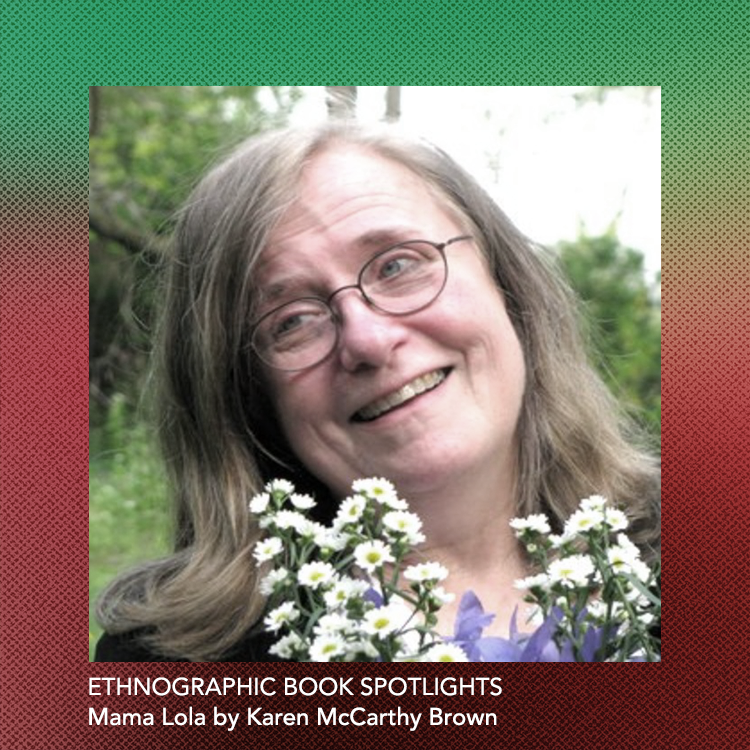
This ethnography explores the practice of Vodou among Haitian immigrants in Fort Greene, Brooklyn through the life story of one priestess, Marie Thérèse Alourdes Macena Champagne Lovinski, and her family. Based on decades-long ethnographic fieldwork and friendship with “Mama Lola” as she was known, McCarthy Brown conveys the role of vodou belief in Haitians’ and Haitian-Americans’ lives, and addresses how the practice is adapted to new physical and social environments in the diaspora.
Watch the full episode:
Resources:
Benedicty-Kokken, A., Glover, K. L., Schuller, M., & Byron, J. P. (Eds.). (2016). The Haiti Exception: Anthropology and the Predicament of Narrative. Liverpool University Press. http://www.jstor.org/stable/j.ctt1gpcbvj
Beckett, G. and Wagner, L. (2022) Haiti Beyond Crisis. Hot Spots, Fieldsights, May 3. https://www.culanth.org/fieldsights/series/haiti-beyond-crisis
Dubois, L. (2001). Vodou and History. Comparative Studies in Society and History, 43(1), 92–100. http://www.jstor.org/stable/2696623
Michel, C. (2006). Vodou in Haiti: Way of Life and Mode of Survival. In: Vodou in Haitian Life and Culture. Palgrave Macmillan, New York. https://doi.org/10.1057/9780312376208_2
Schuller, Mark (ed.) (2005) 'The Anthropological Uses of Haiti: A Longue Durée Approach', in Alessandra Benedicty-Kokken, and others (eds), The Haiti Exception: Anthropology and the Predicaments of Narrative. Liverpool: Liverpool University Press. https://doi.org/10.5949/liverpool/9781781382998.003.0002
Schuller, M. (2021). Haiti: What Does Solidarity Really Mean? Uncommon sense. Anthropology Now, 13(3), 31–41. https://doi.org/10.1080/19428200.2021.2090750